


The Complete Parent’s Guide to Understanding and Managing Child Behavior
How to Use This Guide
How to Use This Guide
This guide is organized to help you move from understanding your child’s behavior to implementing effective strategies. Each section builds on the previous one, but you can also jump to specific sections based on your immediate needs.
If you’re dealing with a crisis: Go directly to Emergency Strategies If you’re just starting: Begin with Understanding Your Child’s Behavior If you want specific solutions: Jump to Common Behavior Challenges If current strategies aren’t working: See Troubleshooting
Understanding Your Child's Behavior
Before you can effectively change behavior, you need to understand why it’s happening. Every behavior your child displays serves a purpose, even when it seems completely irrational to you as an adult.
The Foundation: Why Children Behave the Way They Do

Think of behavior like an iceberg. What you see (the tantrum, the defiance, the aggression) is just the tip. Underneath are the real drivers: unmet needs, undeveloped skills, and environmental factors.
The Hidden Drivers of Challenging Behavior:

When your 4-year-old melts down because you said “no” to candy, they’re not trying to manipulate you. They’re demonstrating that they haven’t yet learned how to:
- Handle disappointment without losing emotional control
- Accept “no” as a final answer
- Ask for compromises appropriately
- Cope with intense feelings of wanting something
When your 8-year-old “forgets” to do homework every day, they’re not being lazy. They might be showing you that they:
- Feel overwhelmed by the task and don’t know how to break it down
- Are avoiding something that makes them feel inadequate
- Haven’t developed organizational systems that work for their brain
- Are seeking your attention, even if it’s negative attention
This changes everything about how you respond. Instead of asking “How do I make this behavior stop?” you start asking “What skill does my child need to learn?”
The ABC Pattern: Your Detective Tool
Every behavior follows a predictable pattern called ABC:
A – Antecedent (What happens right before the behavior) This is your biggest clue about what triggers your child. Antecedents might be:
- Environmental (loud noises, crowds, hunger, tiredness)
- Social (being asked to share, peer conflicts, adult demands)
- Internal (frustration, anxiety, excitement, sensory needs)
B – Behavior (What your child actually does) This is the observable action you want to change. Be specific: instead of “acting out,” describe “throws toys and yells when asked to clean up.”
C – Consequence (What happens immediately after) This determines whether the behavior is more or less likely to happen again. Consequences include both your response and the natural outcomes.
Why This Matters: If the consequence your child experiences makes them more likely to repeat the behavior, that behavior is being reinforced – even if the consequence seems negative to you.
The Four Reasons Children Engage in Challenging Behavior
Research shows that all behavior serves one of four functions. Identifying which function applies to your child’s specific behavior is crucial for choosing the right intervention.
Function 1: Getting Attention Your child learns that certain behaviors reliably get adult attention, even if it’s negative attention like scolding or arguing.
Example: Your child interrupts your phone calls by acting silly or being disruptive. Even though you’re annoyed, they’ve successfully gotten your attention.
What this looks like: Behaviors happen more often when adults are busy or distracted, and often stop when the child gets attention.
Function 2: Escaping or Avoiding Your child uses behavior to get out of demands, activities, or situations they find difficult or unpleasant.
Example: Your child has a meltdown every time you ask them to do homework. Eventually, you either do it with them (removing the independence demand) or let them skip it entirely.
What this looks like: Behaviors happen consistently when specific demands are made, and the child often calms down once the demand is removed.
Function 3: Getting Access to Items or Activities Your child has learned that certain behaviors help them obtain things they want.
Example: Your child whines and negotiates until you give them extra screen time or buy them something at the store.
What this looks like: Behaviors happen most often when the child wants something specific, and they escalate until they get it or a reasonable substitute.
Function 4: Meeting Sensory or Internal Needs Your child engages in behavior because it feels good, helps them self-regulate, or meets a sensory need.
Example: Your child rocks, fidgets, or seeks intense physical activity when they’re overwhelmed or understimulated.
What this looks like: Behaviors happen regardless of what’s going on around them and seem to help the child regulate their internal state.
Why Understanding Function Matters: If your child’s tantrum serves an escape function (getting out of homework), giving them attention during the tantrum won’t solve the problem – but teaching them to ask for breaks appropriately will.
Assessment: Becoming a Behavior Detective
Now that you understand the why behind behavior, you need to become a detective to figure out your specific child’s patterns. This investigation phase is crucial because the same behavior can serve different functions for different children.
Step 1: Choose One Behavior to Focus On
Don’t try to tackle everything at once. Pick the behavior that:
- Happens most frequently OR
- Has the biggest impact on your family OR
- Poses safety concerns
Make it specific and observable: Instead of “being defiant,” focus on “refuses to come to dinner when called” or “throws toys when asked to clean up.”
Step 2: Gather Intelligence for One Week
You’re going to track when, where, and why this behavior happens. This isn’t about judging yourself or your child – it’s about gathering objective information.
Simple Tracking Method: Every time the target behavior happens, quickly note:
- Time and place: “3:30 PM in the kitchen”
- What happened right before: “I asked him to put his backpack away”
- What the behavior looked like: “Yelled ‘no!’ and threw his backpack on the floor”
- What happened after: “I picked up the backpack and put it away myself”
- How long it lasted: “About 2 minutes”
Don’t change anything yet. Just observe and record. You’re looking for patterns.
Step 3: Analyze the Patterns
After a week, review your notes and look for:
Timing patterns: Does the behavior happen more at certain times of day? (Many challenging behaviors increase when children are hungry, tired, or overstimulated)
Location patterns: Are there specific places where behavior is better or worse? (Some children struggle more in busy, noisy environments)
Trigger patterns: What consistently happens right before the behavior? (Transitions, demands, being told “no,” peer conflicts)
Response patterns: How do the adults typically respond? What seems to make the behavior stop? (This tells you what’s reinforcing the behavior)
This analysis tells you:
- What function the behavior serves for your child
- What environmental changes might prevent it
- What skills your child needs to learn
- What responses from you might be accidentally reinforcing it
Step 4: Form Your Hypothesis
Based on your week of observation, complete this sentence: “My child engages in [specific behavior] when [trigger/antecedent] in order to [function/outcome].”

Examples:
- “My child throws toys when I ask her to clean up in order to avoid/escape the cleaning demand.”
- “My child interrupts my conversations when I’m talking to other adults in order to get my attention.”
- “My child has meltdowns when we’re leaving preferred activities in order to communicate frustration and possibly delay the transition.”
This hypothesis guides everything you do next.
Foundation Principles: Your Behavior Management Philosophy
Before diving into specific strategies, you need a clear philosophy about behavior management. These principles should guide every interaction with your child around challenging behavior.
Principle 1: You’re Teaching Life Skills, Not Just Stopping Behavior

Mindset Shift: Instead of asking “How do I make this stop?” ask “What does my child need to learn?”
Every challenging behavior represents a skill your child hasn’t mastered yet. Your job is to be their teacher, not their punisher.
What this looks like in practice: When your child has a meltdown because they can’t find their favorite toy, instead of focusing solely on stopping the crying, you teach them:
- How to ask for help calmly
- How to look systematically for lost items
- How to cope with disappointment when something can’t be found immediately
- How to use words to express frustration
Why this matters: Children who learn these skills become more confident, independent, and emotionally regulated over time. Children who only learn “don’t do that” miss out on developing crucial life capabilities.
Principle 2: Positive Reinforcement Is Your Most Powerful Tool

The Science: Decades of research consistently show that positive reinforcement (adding something good after a behavior) is more effective than punishment (adding something unpleasant) for creating lasting behavior change.
Why punishment often backfires:
- It tells children what NOT to do but doesn’t teach what TO do
- It can create fear, resentment, or sneaky behavior
- It often temporarily suppresses behavior without building better skills
- It can damage your relationship with your child
How to use positive reinforcement effectively:
Be specific in your praise: Instead of “good job,” say “I noticed you took three deep breaths when you felt angry instead of yelling. That’s exactly how to handle big feelings.”
Catch them being good: Look for moments when your child handles things well and acknowledge it immediately. Children repeat behaviors that get positive attention.
Match your enthusiasm to the achievement: Learning to tie shoes gets a different level of excitement than learning to manage anger appropriately.
Focus on effort and progress, not just outcomes: “You kept trying even when that was really hard” teaches persistence better than only praising perfect results.
Principle 3: Consistency Across People and Time Creates Security
Why consistency matters: Children feel most secure when they can predict what will happen. Inconsistent responses create anxiety and actually increase challenging behavior as children “test” to see which response they’ll get.
Creating family consistency:
Weekly family meetings: Spend 15 minutes each week discussing:
- What’s working well with behavior management
- What challenges you’re facing
- Any adjustments needed to your approaches
- How each parent/caregiver is feeling about the current strategies
Written behavior plans: For significant challenges, write down your agreed-upon approach so everyone can reference it. Include:
- What the behavior looks like specifically
- How each adult will respond
- What skills you’re teaching
- How you’ll reinforce positive behavior
Support each other: When one parent is implementing a consequence or trying to help a child calm down, the other parent backs them up rather than undermining or “rescuing.”
Principle 4: Your Relationship Is the Foundation
The relationship bank account: Every interaction with your child either makes a deposit (connection, understanding, positive attention) or a withdrawal (criticism, punishment, conflict). You need far more deposits than withdrawals for behavior management to be effective.
How to keep making deposits even during challenging behavior:

- Separate the behavior from the child: “I love you AND this behavior isn’t acceptable”
- Look for opportunities to connect positively every day
- Repair the relationship after difficult moments
- Focus on your child’s strengths and progress, not just problems
When the relationship is strong:
- Children are more motivated to meet your expectations
- They recover more quickly from upsets
- They’re more likely to come to you with problems
- Discipline feels supportive rather than punitive
Prevention: Setting Your Child Up for Success
The most effective behavior management happens before challenging behavior occurs. By modifying your child’s environment and teaching skills proactively, you can prevent many problems from arising.
Environmental Setup for Success
Think like an environmental engineer: Your child’s physical and social environment should make good behavior easy and challenging behavior difficult.
Physical Environment Modifications:
For children who struggle with focus (homework, chores): Your child will be more successful if their
workspace:

- Has minimal visual distractions (clear walls, organized supplies)
- Includes fidget tools if they help your child think (stress ball, fidget cube)
- Is the right size for their body (feet flat on floor, good lighting)
- Has all necessary materials within reach
- Includes a visual reminder of the steps for their task
For children who get overwhelmed easily: Create spaces in your home that support regulation:
- A designated calm-down area with soft lighting and comfort items
- Noise-reducing options (headphones, quiet spaces)
- Sensory tools that help your child feel grounded (weighted lap pad, textured objects)
- Visual reminders of coping strategies where your child can see them
For children who struggle with organization: Make systems that support independence:
- Hooks at your child’s height for backpacks and jackets
- Clear bins labeled with pictures and words for toy cleanup
- Visual schedules showing daily routines
- Designated spots for important items (homework folder, lunch box)
Routine and Schedule Design
Why routines prevent behavior problems: When children know what to expect and when, they feel more secure and are less likely to resist or melt down during transitions.
Creating effective routines:
Morning routine example: Instead of constant reminders and rushing, create a visual routine chart:
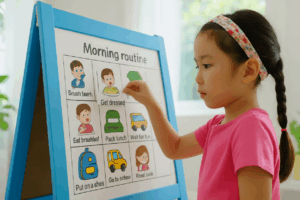
- Get dressed (clothes laid out the night before)
- Brush teeth (toothbrush and toothpaste in designated spot)
- Eat breakfast (options predetermined)
- Pack backpack (using checklist)
- Put on shoes and jacket
- Family connection moment before leaving
The key: Practice the routine during calm times, make it visual, and build in time for connection.
Transition strategies that work: Transitions are often the hardest part of the day for children. Instead of abrupt changes:
Give advance notice: “In 10 minutes, it will be time to clean up toys and come to dinner.” Then follow up at 5 minutes and 2 minutes.
Use timers children can see: Visual timers help children understand how much time they have left.
Create transition rituals: “First we put away our toys, then we wash hands, then we come to the table.” The predictability helps children shift gears.
Build in choice: “Would you like to clean up the blocks first or the art supplies first?” This gives children some control within the structure.
Teaching Skills Before You Need Them
Proactive skill building means teaching your child coping strategies, social skills, and problem-solving during calm moments, so they can use these skills when challenging situations arise.
Emotional regulation skills to practice regularly:
Deep breathing: Practice “bubble breathing” (slow, deep breaths like blowing bubbles) for 2 minutes every day, not just when upset. Make it part of bedtime routine or car rides.
Body awareness: Help children notice physical signs of different emotions. “When you’re frustrated, what do you notice in your body? Tight shoulders? Clenched fists? Faster heartbeat?”
Positive self-talk: Practice phrases like “I can handle this,” “Everyone makes mistakes,” “I’m learning and getting better.” Model this yourself when you face challenges.
Problem-solving steps to practice:
- What’s the problem?
- What are three possible solutions?
- What might happen with each solution?
- Pick one to try
- How did it work?
Use everyday small problems to practice: “Oh no, we’re out of your favorite cereal. Let’s use our problem-solving steps!”
Social skills practice:
Taking turns: Practice with games, conversations, and daily activities
Asking for help: Role-play different ways to ask for help appropriately
Handling disappointment: Practice together when low-stakes disappointments happen
Conflict resolution: Use sibling conflicts or peer problems as teaching opportunities
Response Strategies: What to Do When Challenging Behavior Happens
Despite your best prevention efforts, challenging behavior will still occur. How you respond in these moments determines whether the behavior is more or less likely to happen again.
The Response Hierarchy: Choosing Your Intervention Level
Not every challenging behavior requires the same level of response. Having a clear hierarchy helps you match your response to the situation and avoid over-reacting to minor issues.
Level 1: Environmental and Supportive Interventions (Try These First)
Use these responses when your child is beginning to show signs of frustration or when behavior is mild.

Proximity and presence: Simply moving closer to your child often helps them regulate. Your calm presence can be reassuring.
Environmental modification: “I notice it’s getting loud in here. Would you like to move to a quieter spot?” or “You seem hungry. Let’s get a snack before we tackle homework.”
Offering choices: “Would you like to clean up the art supplies first or the blocks first?” This gives your child some control while still meeting your expectation.
Redirection: “I can see you want to throw something. Let’s go outside and throw a ball” or “You’re having big feelings. Let’s try some deep breathing.”
Additional support: “This seems really hard right now. Would you like me to help you get started?” or “Let’s do this together.”
Level 2: Active Teaching (For Moderate Challenges)
When Level 1 strategies aren’t enough, you move to actively teaching your child what to do instead.
Verbal coaching: “I can see you’re frustrated. What words can you use to tell me about the problem?” or “Remember our rule about gentle hands. Show me how to touch gently.”
Physical guidance: For younger children, you might gently guide their hands to show appropriate touch or help them move away from a situation.
Practice alternative behaviors: “Let’s practice asking for help. Can you try that again with a calm voice?”
Level 3: Clear Limits and Natural Consequences (For Continued Challenges)
When your child continues the challenging behavior despite support and teaching, you implement clear, consistent consequences.
Restate expectations clearly: “The rule is gentle hands. I need you to keep your hands to yourself.”
Natural consequences: If your child throws toys, the toys get put away. If they refuse to wear a coat, they feel cold (unless safety is at risk).
Loss of privilege: If your child misuses a privilege (screen time, playing with friends), they temporarily lose access to that privilege.
Level 4: Separation and Reset (For Intense or Unsafe Behaviors)
When behavior is intense, unsafe, or your child is too dysregulated to learn, separation helps everyone reset.
Time-out or break: A brief separation from the situation to allow emotional regulation
Your own regulation break: “I need a minute to calm down. We’ll talk about this in five minutes.”
Safety first: If behavior is dangerous, your first priority is ensuring everyone’s safety
Implementing Time-Out Effectively
Time-out is one of the most misunderstood and misused behavior management tools. When done correctly, it’s highly effective. When done poorly, it can damage your relationship with your child and increase behavior problems.
When to use time-out:
- Physical aggression toward people or animals
- Dangerous behaviors that could result in injury
- Deliberate destruction of property
- Continued defiance after other strategies have been tried
When NOT to use time-out:
- When your child is seeking attention (this gives them attention)
- For behaviors driven by anxiety or fear
- When you’re angry or out of control yourself
- For children under 18 months (they don’t understand cause and effect yet)
The effective time-out procedure:
Step 1: Give one clear warning “If you hit your sister again, you will need to take a time-out.” Use a calm, matter-of-fact tone.
Step 2: Implement immediately if behavior continues “That’s hitting. Time-out.” Don’t discuss, argue, or give multiple chances.
Step 3: Location and duration
- Boring but safe location away from family activity
- 1 minute per year of age (3-year-old = 3 minutes, maximum 10 minutes for older children)
- Use a timer your child can see
Step 4: The child must be calm before time-out ends If your child is still yelling or protesting when the timer goes off, the time-out isn’t over. They need to be calm for the final 30 seconds.
Step 5: Brief reconnection When time-out is over, briefly acknowledge what happened: “You had a time-out for hitting. I love you, and hitting isn’t safe.” Then return to normal interaction.
Troubleshooting time-out problems:
“My child won’t stay in time-out”:
- Use a backup location like their bedroom
- Restart the timer each time they leave
- Stay calm and consistent
- Consider whether time-out is the right consequence for this child
“Time-out doesn’t seem to work”:
- Make sure the location is truly boring (no toys, screens, or entertainment)
- Check that you’re not accidentally giving attention during time-out
- Consider whether the behavior serves an escape function (time-out might be rewarding)
- Ensure you’re balancing time-out with lots of positive attention for good behavior
De-escalation When Your Child Is Overwhelmed
Sometimes your child’s behavior escalates to the point where they’re too upset to learn or follow directions. In these moments, your goal shifts from teaching to helping them regulate.
Step 1: Ensure safety If behavior is dangerous, your first job is to keep everyone safe. This might mean removing other children, clearing dangerous objects, or even physically intervening if necessary.
Step 2: Stay calm yourself Your emotional regulation helps your child regulate. Take deep breaths, relax your body language, and use a calm tone of voice.
Step 3: Validate their emotions “I can see you’re really upset” or “This is really hard for you right now.” Don’t try to talk them out of their feelings or minimize them.
Step 4: Offer minimal support “I’m here if you need me” or “Would it help if I sat with you?” Don’t overwhelm them with words or suggestions.
Step 5: Wait for the storm to pass Most emotional storms last 3-15 minutes if you don’t add fuel to the fire. Resist the urge to lecture, explain, or fix during the meltdown.
Step 6: Reconnect and problem-solve later Once your child is calm, you can briefly discuss what happened and work on problem-solving for next time.
Teaching Emotional Regulation
Emotional regulation – the ability to experience emotions without being overwhelmed by them – is perhaps the most important life skill you can teach your child. Children aren’t born knowing how to manage big feelings; these skills must be explicitly taught and practiced.
Building Emotional Vocabulary
Before children can manage emotions, they need to recognize and name them. Most children have a very limited emotional vocabulary, which makes it hard for them to communicate their internal experience.
Age-appropriate emotion development:
Ages 2-4: Basic emotion words Start with four core emotions: happy, sad, mad, scared. Use these words throughout the day: “You look happy about going to the park!” or “I can see you’re mad that we have to leave.”
Read books about emotions: Look for picture books that show characters experiencing different feelings and discuss what the characters might be feeling and why.
Use emotion faces: Simple drawings or photos showing different emotional expressions help young children connect internal feelings with external expressions.
Ages 5-8: Expanded vocabulary Add more nuanced emotions: frustrated, disappointed, excited, worried, proud, embarrassed, surprised, grateful.
Connect emotions to body sensations: “When you’re frustrated, what do you notice in your body? Do your muscles feel tight? Does your heart beat faster?”
Discuss emotion intensity: “Are you a little disappointed or very disappointed? Show me with your hands how big that feeling is.”
Ages 9+: Complex emotional understanding Introduce concepts like mixed emotions: “You can feel excited about the sleepover AND nervous about being away from home. Both feelings make sense.”
Emotional triggers and patterns: Help your child notice what tends to trigger certain emotions and what helps them feel better.
The Emotion Thermometer: A Tool for Self-Awareness
Create a visual tool that helps your child identify the intensity of their emotions and choose appropriate coping strategies.
Setting up the thermometer:
Level 1-2 (Green zone): Calm and happy Your child feels relaxed, content, and in control. This is the best time for learning, problem-solving, and trying new things.
Coping strategies: Maintain this state with regular meals, adequate sleep, and positive activities.
Level 3-4 (Yellow zone): Starting to feel upset Your child is beginning to feel frustrated, disappointed, or overwhelmed, but can still think clearly and use coping strategies.
Coping strategies: Deep breathing, asking for help, taking a break, using positive self-talk.
Level 5-6 (Orange zone): Getting more upset Your child is having a harder time thinking clearly and may need adult support to use coping strategies effectively.
Coping strategies: Remove from triggering situation, adult coaching in coping strategies, physical movement to release energy.
Level 7-8 (Red zone): Very upset Your child is having difficulty controlling their behavior and needs significant support to regulate.
Coping strategies: Focus on safety, provide calm adult presence, wait for intensity to decrease before teaching.
Level 9-10 (Purple zone): Completely overwhelmed Your child is in fight-or-flight mode and cannot access reasoning or coping strategies.
Coping strategies: Ensure safety, provide minimal stimulation, wait for the nervous system to calm down.
Teaching the thermometer: Practice using the thermometer during calm times. Ask your child to rate their current feeling level several times a day. Model using it yourself: “I’m feeling about a 6 right now because I’m frustrated about the traffic, so I’m going to take some deep breaths.”
Coping Strategy Toolbox
Different coping strategies work for different children and different situations. Help your child develop a personalized toolbox of strategies they can use at different intensity levels.
Physical regulation strategies:
For releasing energy (when feeling overstimulated or angry):
- Jumping jacks or running in place
- Pushing against a wall
- Dancing to music
- Throwing soft balls into a basket
- Heavy work activities (carrying books, wall push-ups)
For calming down (when feeling anxious or overwhelmed):
- Deep breathing exercises
- Progressive muscle relaxation (tense and release different muscle groups)
- Gentle stretching
- Listening to calming music
- Cuddling with a stuffed animal or pet
Cognitive strategies:
Positive self-talk phrases to practice:
- “This is hard, but I can handle it”
- “Everyone makes mistakes – that’s how we learn”
- “I can try again”
- “It’s okay to feel upset”
- “This feeling will pass”
Problem-solving framework:
- What exactly is the problem?
- What are three things I could try?
- What might happen if I try each option?
- Which one should I try first?
- How did that work? What should I try next?
Mindfulness and grounding techniques:
5-4-3-2-1 grounding: Notice 5 things you can see, 4 things you can touch, 3 things you can hear, 2 things you can smell, 1 thing you can taste.
Mindful breathing: Focus all attention on the sensation of breathing in and out.
Body scan: Notice how each part of your body feels, starting from your toes and moving up to your head.
Teaching Coping Strategies Effectively
Practice during calm times: Don’t wait until your child is upset to introduce coping strategies. Practice when they’re regulated and can learn effectively.
Make it developmentally appropriate: A 4-year-old needs simpler strategies than a 10-year-old. Match the complexity to your child’s abilities.
Let your child choose: Some children respond better to physical strategies, others to cognitive ones. Help your child discover what works best for them.
Model the strategies yourself: When you’re stressed, verbally walk through using a coping strategy: “I’m feeling really frustrated right now. I’m going to take five deep breaths to help myself calm down.”
Celebrate attempts: Praise your child for trying to use coping strategies, even if they don’t work perfectly. “I noticed you tried counting to ten when you were angry. That’s exactly what you should do!”
Common Behavior Challenges and Solutions
This section provides detailed, step-by-step approaches for the most common behavior challenges parents face. Each solution follows the same framework: understand the function, prevent when possible, respond consistently, and teach alternative skills.

Tantrum Behaviors
What tantrums look like: Crying, screaming, throwing oneself on the floor, hitting, kicking, or throwing objects when upset or frustrated.
Understanding the function: Tantrums typically serve one of two functions:
- Escape/avoidance: Getting out of demands or situations the child finds difficult
- Access: Getting something the child wants (attention, items, activities)
Assessment questions to ask yourself:
- When do tantrums typically happen? (during transitions, when told “no,” when given demands?)
- How long do they usually last?
- What typically ends the tantrum?
- Does your child get what they want after the tantrum?
Prevention strategies:
Address basic needs first: Tantrums are more likely when children are hungry, tired, or overstimulated. Ensure regular meals, adequate sleep, and breaks from stimulating environments.
Teach emotion words and coping strategies: During calm times, help your child learn to identify and express emotions: “I can see you’re disappointed that we can’t go to the park. What words can you use to tell me about that feeling?”
Give advance warning for transitions: “In five minutes, it will be time to clean up toys.” Use visual timers so children can see how much time is left.
Offer appropriate choices: “Would you like to brush your teeth first or put on pajamas first?” This gives children some control within your expectations.
Response during tantrums:
Step 1: Ensure safety If your child is throwing objects or could hurt themselves, calmly remove dangerous items or move your child to a safer location.
Step 2: Stay calm and nearby Your calm presence helps your child regulate. Don’t try to reason with them during the tantrum, but let them know you’re there.
Step 3: Don’t give in to the original demand If the tantrum started because you said “no” to something, maintain that boundary. Giving in teaches your child that tantrums work.
Step 4: Wait it out Most tantrums last 3-15 minutes if you don’t add fuel to the fire. Resist the urge to talk, explain, or fix during the storm.
Step 5: Reconnect when calm Once your child has calmed down, offer comfort and connection: “That was really hard. I’m here if you need a hug.”
After tantrums:
Brief problem-solving: “What was the big feeling about? What could we try differently next time?”
Return to the original expectation if appropriate: If the tantrum started because you asked your child to clean up, they still need to clean up once they’re calm.
Practice alternative behaviors: During a calm moment later, practice asking for help, expressing disappointment with words, or using coping strategies.
Troubleshooting tantrum interventions:
“Tantrums are getting longer and more intense”: This might be an extinction burst – behavior often gets worse before it gets better when you stop reinforcing it. Stay consistent with your approach.
“My child has tantrums multiple times every day”: Look for patterns in timing, triggers, and what happens afterward. You may need to address underlying issues like sensory needs, communication difficulties, or environmental stressors.
“I feel embarrassed when my child has tantrums in public”: Remember that tantrums are normal child behavior, not a reflection of your parenting. Stay calm and consistent with your response regardless of the setting.
Non-Compliance with Instructions
What non-compliance looks like: Ignoring instructions, saying “no,” arguing, negotiating when things aren’t negotiable, or simply not following through with requests.
Understanding the function: Non-compliance typically serves an escape/avoidance function – your child is trying to get out of doing something they don’t want to do.
Assessment questions:
- Does your child understand the instruction?
- Is the instruction age-appropriate?
- Are you giving too many instructions at once?
- What happens when your child doesn’t comply?
- Are there times when compliance is better?
Prevention strategies:
Give clear, specific instructions: Instead of: “Go get ready” Try: “Please put your backpack by the front door”
Get your child’s attention first: Make eye contact, use their name, and ensure they’re listening before giving the instruction.
Give one instruction at a time: Especially for younger children, avoid chains of commands like “Put on your shoes, get your backpack, and meet me by the car.”
Make instructions age-appropriate: A 3-year-old can carry their plate to the counter but probably can’t clear the entire table independently.
Use “when/then” language: “When you put your toys away, then we can read a story together.”
Response to non-compliance:
Step 1: Wait and give processing time Count to 10 in your head before repeating the instruction. Some children need more time to process and respond.
Step 2: Give one calm reminder “I asked you to put your backpack by the door. Please do that now.”
Step 3: Offer minimal help if needed “Would you like me to walk with you to get your backpack?” Sometimes children need just a little support to get started.
Step 4: Implement consequences for continued non-compliance This might be guided compliance (you help them do it), loss of a privilege, or a natural consequence.
Teaching compliance skills:
Practice during easy times: Start with instructions your child likes to follow (getting a snack, playing a game) and build up to more difficult requests.
Explain the “why” when appropriate: “We need to clean up our toys so no one trips and gets hurt.” But don’t turn every instruction into a negotiation.
Acknowledge compliance: “Thank you for putting your backpack away when I asked. That helps our family get ready efficiently.”
Create routines that reduce the need for constant instructions: Visual schedules and consistent routines help children know what to do without constant prompting.
Sibling Conflict
What sibling conflict looks like: Fighting over toys, name-calling, tattling, physical aggression between siblings, or competition for parent attention.
Understanding the function: Sibling conflicts often serve multiple functions:
- Access: Getting preferred toys, activities, or space
- Attention: Getting parent involvement and attention
- Escape: Getting away from a sibling who is bothering them
Prevention strategies:
Establish clear family rules about sibling interactions:
- Use gentle hands and voices with family members
- Ask before taking something that belongs to someone else
- Take turns with shared items
- Come to parents for help before conflicts escalate
Teach conflict resolution skills: During calm times, practice these steps:
- Each person gets to say their side without interruption
- Listen to understand, not just to argue back
- Brainstorm solutions that could work for everyone
- Try one solution and see how it goes
Create individual space and time: Each child needs some toys, space, and activities that are just theirs and don’t have to be shared.
Give individual attention: Children who feel secure in their relationship with you are less likely to compete with siblings for your attention.
Response during conflicts:
Step 1: Intervene minimally when possible If children are arguing but not hurting each other or damaging property, give them a chance to work it out themselves.
Step 2: Separate if needed “I can see you’re both really upset. Let’s take a break from playing together. You can try again in 10 minutes.”
Step 3: Focus on problem-solving, not blame “What’s the problem here? What are some solutions that could work for both of you?” Avoid determining who was “right” or “wrong.”
Step 4: Coach conflict resolution Help children practice the skills they need: “Can you tell your brother how you feel using words instead of hitting?”
Step 5: Follow through with consequences if needed If children can’t solve the conflict peacefully, they may lose the privilege of playing together or with the disputed item.
Teaching positive sibling relationships:
Model and encourage kindness: Notice and praise when siblings are being kind, helpful, or patient with each other.
Create cooperative goals: “Let’s see if you two can work together to clean up the playroom before dinner.”
Avoid comparisons: Don’t use one child’s behavior to motivate another (“Why can’t you be helpful like your sister?”).
Address each child’s needs individually: Children with different temperaments, ages, and needs require different approaches.
Bedtime Resistance
What bedtime resistance looks like: Stalling tactics, repeated requests for “one more” thing, getting out of bed repeatedly, tantrums about bedtime, or taking hours to fall asleep.
Understanding the function: Bedtime resistance typically serves an escape/avoidance function (avoiding separation from parents and fun activities) and sometimes an attention function (getting extra parent interaction).
Prevention strategies:
Create a consistent, calming bedtime routine: A predictable sequence helps children’s bodies and minds prepare for sleep. A typical routine might include:
- Bath or face/hands washing
- Putting on pajamas
- Brushing teeth
- Quiet activity (reading, soft music)
- Brief family connection time
- Lights out
Start the routine early enough: Work backward from your desired sleep time. If bedtime is 8:00 PM, you might start the routine at 7:30 PM.
Reduce stimulation gradually: Dim lights, turn off screens, and transition to quieter activities as bedtime approaches.
Address common concerns during the day: If your child worries about monsters or has trouble separating, address these concerns during daytime conversations, not at bedtime.
Response to bedtime resistance:
Stay calm and consistent: Bedtime battles often escalate when parents become frustrated. Keep your voice calm and your expectations clear.
Use minimal interaction for stalling: “It’s time for sleep. I’ll see you in the morning.” Don’t engage in lengthy conversations or negotiations.
Return children to bed consistently: If your child gets up, calmly walk them back to bed with minimal talking. Be prepared to do this multiple times initially.
Set clear boundaries: “After story time, it’s time for sleep. I’ll check on you once, but then it’s time to rest your body.”
Teaching independent sleep skills:
Comfort objects: A special stuffed animal or blanket can provide security when parents aren’t in the room.
Self-soothing strategies: Teach your child calming techniques they can use independently: deep breathing, thinking about happy memories, or listening to their body relax.
Gradual independence: If your child is used to having a parent present until they fall asleep, gradually reduce your presence over time.
Troubleshooting bedtime issues:
“My child says they’re not tired”: Maintain consistent bedtime regardless of whether your child feels tired. Bodies need consistent sleep schedules to regulate properly.
“Bedtime takes hours every night”: You may need to temporarily make bedtime earlier and be very consistent about not engaging with stalling behaviors.
“My child has nightmares or fears”: Address fears with comfort and reassurance, but avoid creating elaborate rituals that could increase anxiety.
Building and Repairing Relationships
Strong parent-child relationships are the foundation of effective behavior management. When children feel connected to and secure with their parents, they’re more motivated to meet expectations and more resilient when facing challenges.
Daily Connection Rituals

The science of connection: Research shows that children need multiple positive interactions with parents throughout the day to feel secure and valued. The ratio should be at least 5 positive interactions for every 1 negative interaction.
Morning connection (5 minutes): Start each day with intentional connection rather than immediately jumping into demands and schedules.
What this looks like:
- Special greeting or physical affection (if your child enjoys it)
- Brief conversation about the day ahead: “What are you looking forward to today?”
- Express confidence in your child: “I know you’re going to handle whatever comes up today”
- Share something you’re excited about: “I’m looking forward to hearing about your science project tonight”
Why this matters: Starting the day with connection sets a positive tone and fills your child’s emotional tank before they face the challenges of the day.
After-school/after-work reconnection (10-15 minutes): When families reunite after being apart, children need time to reconnect before jumping into homework, chores, or other demands.
What this looks like:
- Put away phones and give full attention to your child
- Ask open-ended questions: “Tell me about the best part of your day” rather than “How was school?”
- Listen without immediately trying to fix problems or give advice
- Share something from your own day
- Physical presence: sit next to your child, make eye contact
Why this matters: Children often save up their emotions throughout the day and need to decompress with their safe person (you) before they can handle additional expectations.
Bedtime connection (10-15 minutes): End each day with positive connection, regardless of how challenging the day might have been.
What this looks like:
- Gratitude sharing: each person shares something good from the day
- Reading together or quiet conversation
- Physical affection: back rubs, cuddling, holding hands
- Expressions of love: “I’m so glad you’re my child”
- Looking forward to tomorrow: “I’m excited to see you in the morning”
Why this matters: Children sleep better when they feel emotionally secure, and ending on a positive note helps repair any relationship stress from the day.
Special Time: Dedicated One-on-One Connection
What special time is: Regularly scheduled, uninterrupted time when your child has your complete attention and gets to direct the activity (within reason).
How to implement special time:
Frequency and duration:
- Younger children (ages 2-6): 10-15 minutes daily or 30 minutes several times per week
- School-age children (ages 7-12): 15-30 minutes several times per week
- Adolescents (ages 13+): 30-60 minutes weekly, often around an activity they enjoy
Child-directed activities: Your child chooses what to do during special time. This might include:
- Playing games they enjoy
- Art or craft activities
- Building with blocks or LEGOs
- Pretend play
- Simple cooking or baking
- Outdoor activities
Your role during special time:
- Follow your child’s lead
- Avoid teaching, correcting, or directing unless safety is at risk
- Show genuine interest in what your child is showing you
- Keep phones and other distractions away
- Focus on connection rather than accomplishment
What special time is NOT:
- Screen time together (this doesn’t build connection the same way)
- Time for teaching or correcting behavior
- Contingent on good behavior (special time happens regardless)
- An opportunity to sneak in discussions about problems
Why special time works:
- Children feel valued and important when they have your undivided attention
- You get to see your child’s interests, strengths, and personality
- It provides positive interactions that balance out necessary corrections and demands
- Children are more cooperative when their need for connection is met
Repairing Relationships After Difficult Moments
The reality of family life: Every family has difficult moments, conflicts, and times when parents and children don’t handle situations well. The key to maintaining strong relationships isn’t perfection – it’s repair.
The repair process:
Step 1: Take care of your own emotional state first You can’t help your child regulate if you’re still dysregulated yourself. Take a few minutes to calm down if needed.
Step 2: Approach your child with curiosity and care “That was really hard for both of us. How are you feeling now?”
Step 3: Acknowledge what happened without rehashing details “We both got pretty upset earlier” rather than going through everything that went wrong.
Step 4: Take responsibility for your part “I wish I had stayed calmer when I was frustrated” or “I should have listened to your feelings before jumping to consequences.”
Step 5: Reconnect emotionally Physical affection, eye contact, or simply sitting together can help rebuild connection.
Step 6: Problem-solve for the future if appropriate “What could we both try differently if this happens again?” Focus on solutions rather than blame.
Step 7: Reaffirm your love and relationship “Even when we have hard times, I always love you” or “Nothing you do will ever change how much I love you.”
What repair does:
- Shows your child that relationships can be strong even after conflict
- Models accountability and emotional responsibility
- Reduces shame and helps children learn from mistakes
- Strengthens trust and security in the relationship
What repair is not:
- Letting your child off the hook for inappropriate behavior
- Taking all the blame when your child made poor choices
- Avoiding consequences that are still needed
- A one-time conversation that fixes everything immediately
Building Your Child’s Self-Worth
Connection between self-worth and behavior: Children who feel valued, capable, and loved are more likely to make positive choices and more resilient when facing challenges.
Strategies for building self-worth:
Focus on effort and character rather than just achievement: Instead of: “You’re so smart!” Try: “You worked really hard on that math problem and didn’t give up even when it was difficult.”
Notice and verbalize your child’s positive qualities: “I noticed how kind you were to your friend when she was sad” or “You have such a great sense of humor – you always know how to make people laugh.”
Create opportunities for contribution and competence: Give your child age-appropriate ways to contribute to the family: setting the table, feeding pets, helping with meal preparation. When children feel needed and capable, their self-worth grows.
Avoid comparison with others: Focus on your child’s individual growth rather than how they compare to siblings, classmates, or other children.
Celebrate uniqueness: Help your child identify and appreciate their individual strengths, interests, and qualities that make them special.
Show interest in your child’s world: Learn about their friends, interests, worries, and dreams. When children feel that their internal world matters to you, they feel valued as individuals.
School Collaboration
Many behavioral challenges occur in school settings, and successful intervention requires coordination between home and school. When parents and teachers work together consistently, children receive the support they need across all environments.
Understanding School Behavior Dynamics

Why behavior might be different at school: Children often behave differently at school than at home due to:
Different expectations and structure: Schools typically have more rigid schedules, higher adult-to-child ratios, and different behavioral expectations than home.
Peer influences: The presence of other children can trigger different behaviors, both positive and negative.
Academic demands: Some children struggle with the cognitive load of school tasks, leading to behavioral responses.
Sensory environment: Classrooms can be overstimulating for some children (noise, visual distractions, crowding) or understimulating for others.
Different relationships: Your child’s relationship with their teacher may trigger different responses than their relationship with you.
Functional Behavior Assessment in Schools
If your child is having significant behavioral challenges at school, you can request a Functional Behavior Assessment (FBA). This is a systematic way of understanding why behaviors are occurring in the school environment.
What an FBA includes:
- Detailed observation of when, where, and why behaviors occur at school
- Interviews with teachers, staff, and your child
- Review of academic work and any learning challenges
- Analysis of the function the behavior serves in the school environment
How to request an FBA: Write a formal letter to your child’s school requesting an FBA. Include:
- Specific behaviors you’re concerned about
- When these behaviors typically occur
- How they’re impacting your child’s learning or social relationships
- Your request for a comprehensive assessment
What happens after the FBA: The school team creates a Behavior Intervention Plan (BIP) that includes:
- Strategies to prevent the behavior
- How staff will respond when the behavior occurs
- What replacement behaviors will be taught
- How progress will be monitored
Home-School Communication Strategies
Regular communication systems:
Daily report cards: Simple tracking sheets that travel between home and school, focusing on 2-3 specific behavioral goals.
Example daily report card:
- Followed directions the first time given: Yes/No
- Used appropriate voice level: Yes/No
- Kept hands and feet to self: Yes/No
- Teacher signature and brief note
Weekly check-ins: Scheduled brief conversations (phone or email) between parents and teachers to discuss progress and adjust strategies.
Shared behavior plans: Written plans that outline how specific behaviors will be addressed consistently at home and school.
Effective communication with teachers:
Be specific about concerns: Instead of “My child is having behavior problems,” provide specific examples: “Jake has been refusing to do his math homework and tears up his papers when he gets frustrated.”
Share what works at home: “When Jake feels overwhelmed, we find that giving him a 2-minute break to walk around helps him refocus.”
Ask for specific information: “Can you tell me what typically happens right before Jake refuses to do his work?” or “What time of day do you notice these behaviors most?”
Collaborative problem-solving: “What strategies have you tried that seem helpful? What can we do at home to support what you’re working on at school?”
Supporting School Success at Home
Homework strategies that reduce behavioral issues:
Create a consistent homework environment:
- Designated workspace with minimal distractions
- All necessary supplies easily accessible
- Consistent time for homework (not necessarily immediately after school)
- Adequate lighting and comfortable seating
Break large assignments into manageable chunks: If your child gets overwhelmed by homework, help them break it down: “Let’s do 5 math problems, then take a 2-minute break, then do 5 more.”
Provide appropriate support without doing the work:
- Help your child organize their materials
- Read instructions aloud if helpful
- Encourage and celebrate effort
- Help with time management and planning
Communicate with teachers about homework challenges: If homework consistently takes much longer than expected or causes significant distress, discuss modifications with your child’s teacher.
Social skills support:
Practice social situations at home: Role-play common school scenarios: asking to join a game, handling peer conflicts, asking for help from teachers.
Discuss friendship skills: Talk about what makes a good friend, how to handle peer pressure, and how to resolve conflicts peacefully.
Support but don’t solve all peer problems: Help your child brainstorm solutions to peer conflicts, but avoid jumping in to fix every social issue.
Academic support that prevents behavioral issues:
Read together daily: This supports academic skills and provides positive connection time.
Practice skills in low-pressure ways: Use games, everyday activities, and fun contexts to reinforce academic concepts.
Communicate with teachers about learning challenges: If you notice your child struggling with certain academic areas, share this information with teachers early.
Advocate for appropriate support: If your child needs additional academic support, work with the school to ensure they receive it.
When to Seek Professional Help

While many behavioral challenges can be successfully addressed using the strategies in this guide, some situations require professional support. Knowing when and how to seek help can make a significant difference in your child’s development and your family’s well-being.
Clear Indicators for Professional Assessment
Safety concerns that require immediate professional help:
Aggressive behaviors: If your child frequently hits, kicks, bites, or throws objects at people in ways that could cause injury, professional intervention is needed.
Self-harm behaviors: Any behaviors where your child deliberately hurts themselves (hitting themselves, head-banging, scratching) require immediate professional assessment.
Dangerous risk-taking: Behaviors that put your child or others at serious risk (running into traffic, climbing dangerously high, playing with dangerous objects) need professional evaluation.
Threats of harm: If your child talks about wanting to hurt themselves or others, seek professional help immediately.
Persistent challenges despite consistent intervention:
Behaviors interfering with daily functioning: If challenging behaviors prevent your child from participating in school, family activities, or peer relationships despite months of consistent intervention.
Extreme reactions to normal situations: If your child has intense, prolonged reactions to everyday situations (transitions, minor changes, typical demands) that seem far out of proportion to the trigger.
Regression in development: If your child loses previously mastered skills (toilet training, sleeping through the night, communication abilities) without an obvious medical cause.
Multiple challenging behaviors: If your child displays several different challenging behaviors across multiple settings (home, school, community) that don’t improve with intervention.
Family impact indicators:
Chronic family stress: If behavior management dominates family life and causes ongoing stress for parents and siblings despite implementing strategies consistently.
Social isolation: If your family avoids social situations, family gatherings, or community activities because of behavioral challenges.
Parental burnout: If you feel overwhelmed, hopeless, or unable to cope despite trying multiple approaches.
Impact on siblings: If other children in the family are being negatively affected by the ongoing behavioral challenges.
Types of Professional Support
Board Certified Behavior Analysts (BCBAs):
What they do:
- Conduct comprehensive functional behavior assessments
- Develop detailed behavior intervention plans
- Train parents and teachers in implementation strategies
- Monitor progress and adjust interventions based on data
When to consider a BCBA:
- When you need help understanding why behaviors are occurring
- When multiple intervention attempts haven’t been successful
- When behaviors are severe or dangerous
- When you need coordination between home and school interventions
How to find a BCBA:
- Ask your child’s pediatrician for referrals
- Contact your insurance company for covered providers
- Search the Behavior Analyst Certification Board website for certified professionals in your area
Child psychologists and psychiatrists:
What they do:
- Assess for underlying mental health conditions
- Provide therapy for emotional regulation difficulties
- Offer family therapy and parent training programs
- Prescribe medication if appropriate (psychiatrists)
When to consider a psychologist or psychiatrist:
- When behaviors seem driven by anxiety, depression, or trauma
- When your child expresses persistent negative thoughts about themselves
- When traditional behavior management approaches aren’t effective
- When you suspect underlying conditions like ADHD, autism, or anxiety disorders
Developmental pediatricians:
What they do:
- Evaluate for developmental delays or differences
- Screen for conditions like ADHD, autism spectrum disorders, or learning disabilities
- Coordinate care between multiple providers
- Consider medical factors that might be affecting behavior
When to consider a developmental pediatrician:
- When you have concerns about your child’s development in multiple areas
- When you suspect an underlying condition might be contributing to behavioral challenges
- When you need comprehensive evaluation and care coordination
School-based support services:
What they provide:
- Special education evaluations and services
- 504 plans for classroom accommodations
- Behavior intervention planning
- Social skills groups and counseling services
How to access school services:
- Request an evaluation in writing from your child’s school
- Attend meetings to discuss your child’s needs
- Collaborate on developing appropriate support plans
Preparing for Professional Consultations
Information to gather before your appointment:
Detailed behavior logs: Keep track of specific behaviors for at least 2 weeks, including when they occur, what triggers them, and how long they last.
Video examples: If possible, short video clips of challenging behaviors can help professionals understand exactly what you’re dealing with.
Developmental and medical history: Information about your child’s early development, any medical issues, and family history of behavioral or mental health concerns.
Previous interventions: List what strategies you’ve tried, how long you implemented them, and what the results were.
School information: Report cards, teacher comments, and any school-based assessments or interventions.
Questions to ask professionals:
About assessment and diagnosis:
- What specific assessments will you conduct?
- How long will the evaluation process take?
- What conditions or factors are you considering?
- How will you involve our family in the assessment process?
About treatment recommendations:
- What specific interventions do you recommend?
- How will these interventions address our child’s specific needs?
- What is the expected timeline for seeing improvement?
- How will we measure progress?
About implementation:
- How will you train our family to implement strategies?
- How often will we meet to review progress?
- How will you coordinate with our child’s school?
- What should we do if strategies aren’t working?
About your role as parents:
- What will be expected of us as parents?
- How can we best support our child during this process?
- What warning signs should we watch for?
- When should we contact you between appointments?
Working Effectively with Professionals

Building a collaborative relationship:
Be honest about your concerns and challenges: Professionals can only help effectively if they understand the full picture of what you’re experiencing.
Ask questions when you don’t understand: Don’t hesitate to ask for clarification about diagnoses, treatment recommendations, or implementation strategies.
Share your observations: You know your child better than anyone. Your insights about what works and what doesn’t are valuable information.
Communicate about what fits your family: If recommendations don’t seem realistic for your family’s schedule, resources, or values, discuss modifications.
Following through with recommendations:
Implement strategies consistently: Professional interventions only work if they’re implemented as recommended. If you’re having trouble with consistency, discuss barriers with your provider.
Track progress: Keep data on your child’s behavior so you and your professional can make informed decisions about adjustments.
Communicate regularly: Stay in touch with your provider about how things are going, even if you don’t have scheduled appointments.
Be patient with the process: Behavior change takes time, and some interventions may take weeks or months to show significant results.
Troubleshooting: When Strategies Aren't Working
Even the most well-designed behavior management plans sometimes don’t work as expected. When you’ve been implementing strategies consistently but aren’t seeing improvement, it’s time to troubleshoot and adjust your approach.
Systematic Problem-Solving Process
Step 1: Evaluate implementation fidelity
Before assuming a strategy isn’t working, honestly assess whether it’s being implemented correctly and consistently.
Questions to ask yourself:
- Are all caregivers using the same approach?
- Are we implementing strategies exactly as planned?
- Are we being consistent across different settings and times?
- Are there gaps in our implementation that might be undermining success?
Common implementation problems:
- Different responses from different caregivers
- Inconsistency between home and school
- Giving in to behaviors occasionally
- Not following through with planned consequences
- Implementing strategies only when convenient
How to fix implementation issues:
- Schedule a family meeting to review and recommit to your approach
- Create written reminders of your strategies
- Practice responses during calm times
- Set up systems for better communication between caregivers
Step 2: Reassess the function of behavior
If strategies aren’t working, you may have incorrectly identified why your child is engaging in the behavior.
Re-examine your data:
- Look at your behavior tracking logs again
- Consider whether the behavior might serve multiple functions
- Think about whether the function might be different in different settings
- Consider whether your child’s needs have changed
Signs you may have misidentified the function:
- Attention-seeking interventions aren’t working (behavior might serve escape function)
- Escape-prevention strategies aren’t helping (behavior might be attention-seeking)
- Child seems to enjoy consequences you thought would be deterrents
- Behavior increases when you remove what you thought was reinforcing it
How to reassess function:
- Conduct a more detailed functional assessment
- Try different intervention approaches to see what works
- Consult with a behavior professional if needed
- Consider underlying factors you might have missed
Step 3: Look for competing reinforcers
Sometimes strategies don’t work because the child is still getting reinforcement for the challenging behavior from other sources.
Questions to consider:
- Is your child getting attention from siblings or peers for the behavior?
- Are there natural consequences that might be reinforcing the behavior?
- Is the behavior serving a sensory function you haven’t addressed?
- Are there competing motivations you haven’t considered?
Common competing reinforcers:
- Sibling reactions that provide entertainment
- Getting out of non-preferred activities even temporarily
- Sensory stimulation from the behavior itself
- Adult attention even when it’s meant to be neutral
How to address competing reinforcers:
- Identify all possible sources of reinforcement
- Work to minimize or eliminate competing reinforcers
- Make sure appropriate behaviors are more reinforcing than inappropriate ones
- Consider environmental modifications to reduce competing motivations
Common Implementation Challenges
Challenge: Inconsistency between caregivers
Why this happens:
- Different comfort levels with various strategies
- Disagreement about expectations or severity of consequences
- Lack of communication about what’s working
- Different relationships with the child
Solutions:
- Hold regular family meetings to discuss approach and make adjustments
- Create written behavior plans that everyone can reference
- Practice difficult scenarios together before they occur
- Assign primary responsibility for specific situations to reduce confusion
- Seek outside support if parents fundamentally disagree on approach
Challenge: Extinction burst – behaviors getting worse before they get better
What this looks like: When you stop reinforcing a behavior that previously worked for your child, they often increase the intensity, frequency, or duration of the behavior before it starts to decrease.
Why this happens: Your child has learned that this behavior usually works, so when it stops working, they try harder. This is actually a sign that your intervention is working.
How to handle extinction bursts:
- Prepare all caregivers for this possibility
- Stay consistent with your new approach
- Ensure safety during increased intensity
- Focus extra attention on reinforcing appropriate alternative behaviors
- Remember that this indicates your intervention is working, not failing
Challenge: Regression during stress or major changes
Common triggers for regression:
- Family changes (new baby, divorce, moving)
- School transitions or difficulties
- Illness or medical procedures
- Seasonal changes or holiday disruptions
- Developmental growth spurts
How to manage regression:
- Temporarily return to more intensive support
- Increase structure and predictability during transitions
- Provide extra emotional support and connection time
- Adjust expectations temporarily while maintaining core boundaries
- Communicate with all caregivers about the temporary nature of increased support
Challenge: Strategies work at home but not at school (or vice versa)
Why this happens:
- Different environments have different triggers and reinforcers
- Expectations may be different across settings
- The function of behavior might be different in different environments
- Implementation might be inconsistent across settings
Solutions:
- Conduct separate functional assessments for different environments
- Improve communication between home and school
- Adapt strategies to fit the specific environment while maintaining core principles
- Provide training and support to teachers or other caregivers
- Consider whether different approaches are needed for different settings
When to Modify Your Approach
Indicators that modifications are needed:
No improvement after 4-6 weeks of consistent implementation: If you’ve been implementing strategies consistently and haven’t seen any positive changes, it’s time to reassess and modify.
Behaviors are getting significantly worse: While some increase (extinction burst) is normal, if behaviors are becoming more dangerous or significantly more frequent, adjustments are needed.
Strategies are causing other problems: If your behavior management approach is creating new problems (family conflict, your child becoming withdrawn, other behaviors emerging), modifications are necessary.
Your child seems more distressed or your relationship is suffering: Effective behavior management should ultimately improve your child’s emotional well-being and your relationship, not damage them.
Modification strategies:
Adjust the intensity of your approach:
- You might need more frequent reinforcement
- Consequences might need to be more immediate or more meaningful
- You might need additional environmental supports
Change the specific strategies while maintaining core principles:
- Try different types of reinforcers
- Modify the timing of interventions
- Adjust the level of support provided
Address underlying factors you might have missed:
- Consider sensory needs
- Evaluate for possible medical issues
- Assess whether academic or social challenges are contributing
- Look at family stress factors that might be affecting your child
Seek additional support:
- Consult with your child’s pediatrician
- Consider professional behavior assessment
- Look into parent training programs
- Evaluate whether your child needs additional services
Maintaining Your Own Well-Being
The importance of parent self-care: Managing challenging behavior is emotionally and physically exhausting. Your own well-being directly impacts your ability to support your child effectively.
Signs that you need additional support:
- Feeling hopeless or overwhelmed most of the time
- Using behavior management strategies out of anger rather than intention
- Avoiding situations or isolating your family due to behavior challenges
- Physical symptoms of stress (headaches, sleep problems, changes in appetite)
- Relationship conflicts with your partner about behavior management
Self-care strategies:
- Take regular breaks from behavior management when possible
- Connect with other parents facing similar challenges
- Maintain your own interests and relationships outside of parenting
- Seek individual therapy or counseling if needed
- Remember that seeking help is a sign of strength, not failure
Building your support network:
- Connect with other families who understand your challenges
- Maintain relationships with friends and family who can provide emotional support
- Consider joining parent support groups
- Don’t hesitate to accept offers of help from others
Tools and Resources
This section provides practical tools, templates, and resources you can use immediately to implement the strategies discussed throughout this guide.
Behavior Tracking and Data Collection Tools
Daily Behavior Tracking Sheet
Use this simple form to track one target behavior for a week:
Child’s Name: _________________ Target Behavior: _________________
Week of: _________________
| Day/Date | Time | Setting | What happened before? | What did child do? | What happened after? | Duration | Notes |
|———-|——|———|———————-|——————-|——————-|———-|——–|
| Monday |
| Tuesday |
End of week analysis:
– What patterns do you notice?
– What function might this behavior serve?
– What strategies will you try next week?
Simple Daily Report Card (Home-School Communication)
Student: _________________ Date: _________________
Morning Goals:
□ Followed directions within 30 seconds
□ Used calm voice when speaking
□ Kept hands and feet to self
Afternoon Goals:
□ Followed directions within 30 seconds
□ Used calm voice when speaking
□ Kept hands and feet to self
Teacher signature: _________________
Notes: _________________________________________________
Parent signature: _________________
Home consequence: ___________________________________
Visual Supports and Schedules
Daily Schedule Template
Create picture cards or written schedules for your child’s daily routine:
Morning Routine:
- Wake up and get dressed
- Brush teeth
- Eat breakfast
- Pack backpack
- Put on shoes and jacket
- Leave for school
After School Routine:
- Put backpack in designated spot
- Wash hands and have snack
- Homework time
- Free play
- Help with dinner preparation
- Family dinner
Bedtime Routine:
- Clean up toys
- Take bath or wash face and hands
- Brush teeth
- Put on pajamas
- Read story
- Lights out
Feeling Thermometer
Create a large visual display showing emotion levels:
10 – EXPLOSIVE: Can’t think clearly, need safety first
9 – FURIOUS: Very hard to control behavior
8 – REALLY MAD: Need adult help to calm down
7 – ANGRY: Can try coping strategies with support
6 – FRUSTRATED: Getting upset, need to use strategies
5 – BOTHERED: A little annoyed, can handle independently
4 – SLIGHTLY UPSET: Minor irritation
3 – NEUTRAL: Feeling okay
2 – CONTENT:

By Numuw


You're not Alone, Let us Help!
Numuw is the MENA region's first child and adolescent therapy delivery platform. With over 20 years of experience, our dynamic team provides expert care for your child and support for you.
Subscribe to Our Newsletters